
Commercial Roof Restoration
Modified Bitumen Silicone Coating at Gulf Coast Orthodontics, Fort Myers
Metropolis Avenue in South Fort Myers is one of the busiest medical corridors in the area, sitting right across from Gulf Coast Medical Center and packed with offices seeing patients every day. For a practice like Gulf Coast Orthodontics, there's just no room for interior ceiling leaks, mold concerns, or the noise of construction happening overhead while patients are in the chair. So when commercial building owner R&H Investments, LLC started noticing moisture problems and ponding water on the flat roof, they came to McKinnis Roofing & Sheet Metal looking for a solution that wouldn't shut the practice down.
Instead of putting the office through a loud, dusty, expensive full tear-off, we took a close look at the existing modified bitumen roof and designed a silicone coating restoration paired with drainage repairs — a solution that could solve the actual problem without disrupting a single day of patient appointments.
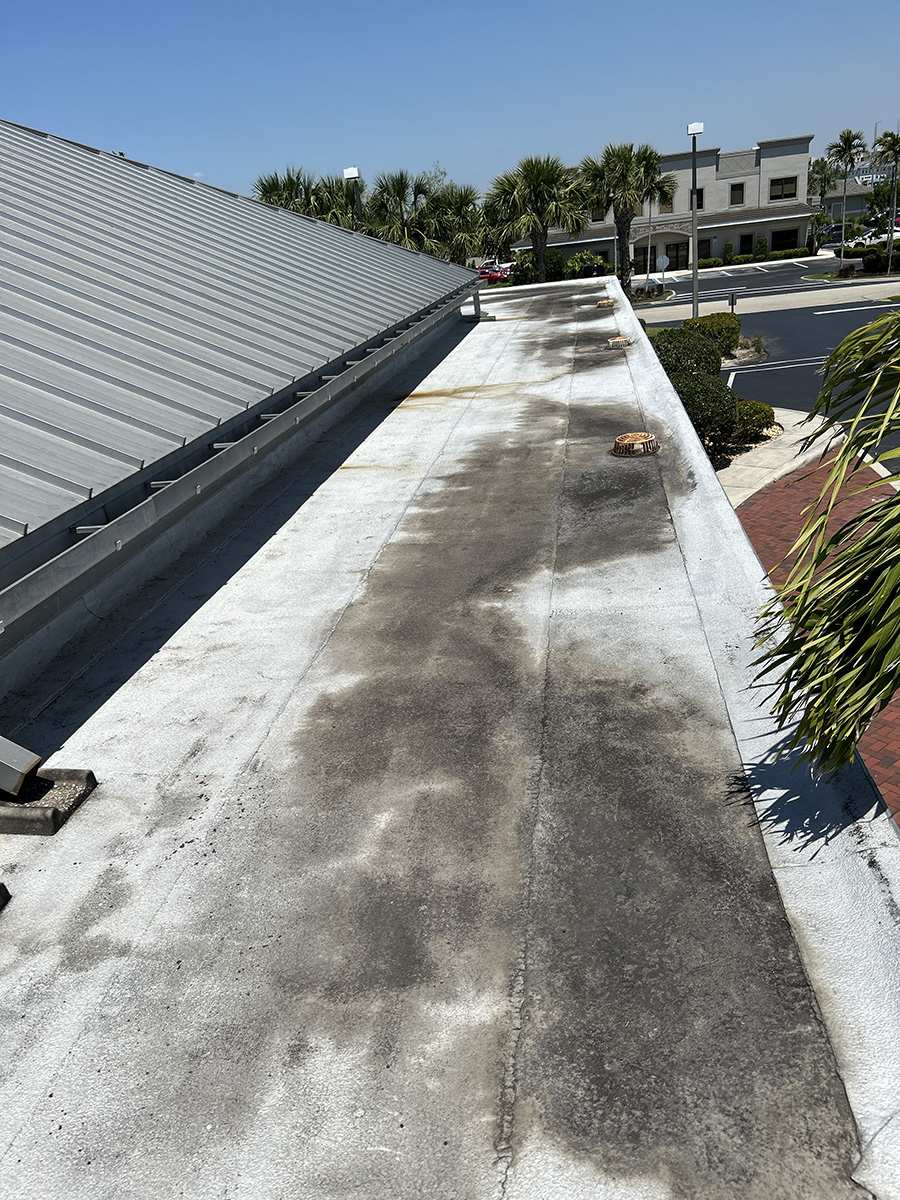
What We Found: Ponding Water and a Rogue Drain Line
During our inspection at 14361 Metropolis Avenue, our commercial team found that the multi-ply modified bitumen membrane was still structurally sound across most of the roof, but showing real wear at the stress points. Years of Southwest Florida sun had dried out the surface asphalt, and several perimeter seams and gutter joints were starting to pull apart.
But the bigger issue turned out to be something most people wouldn't think to check: a damaged, poorly routed PVC condensate drain line from the building's HVAC system. Instead of draining into the roof's designated drain, broken fittings were dumping gallons of AC runoff straight onto the membrane every single day. In Florida's heat, that kind of constant discharge creates standing water that attracts algae, breaks down the asphalt underneath, and eventually works its way into the seams.
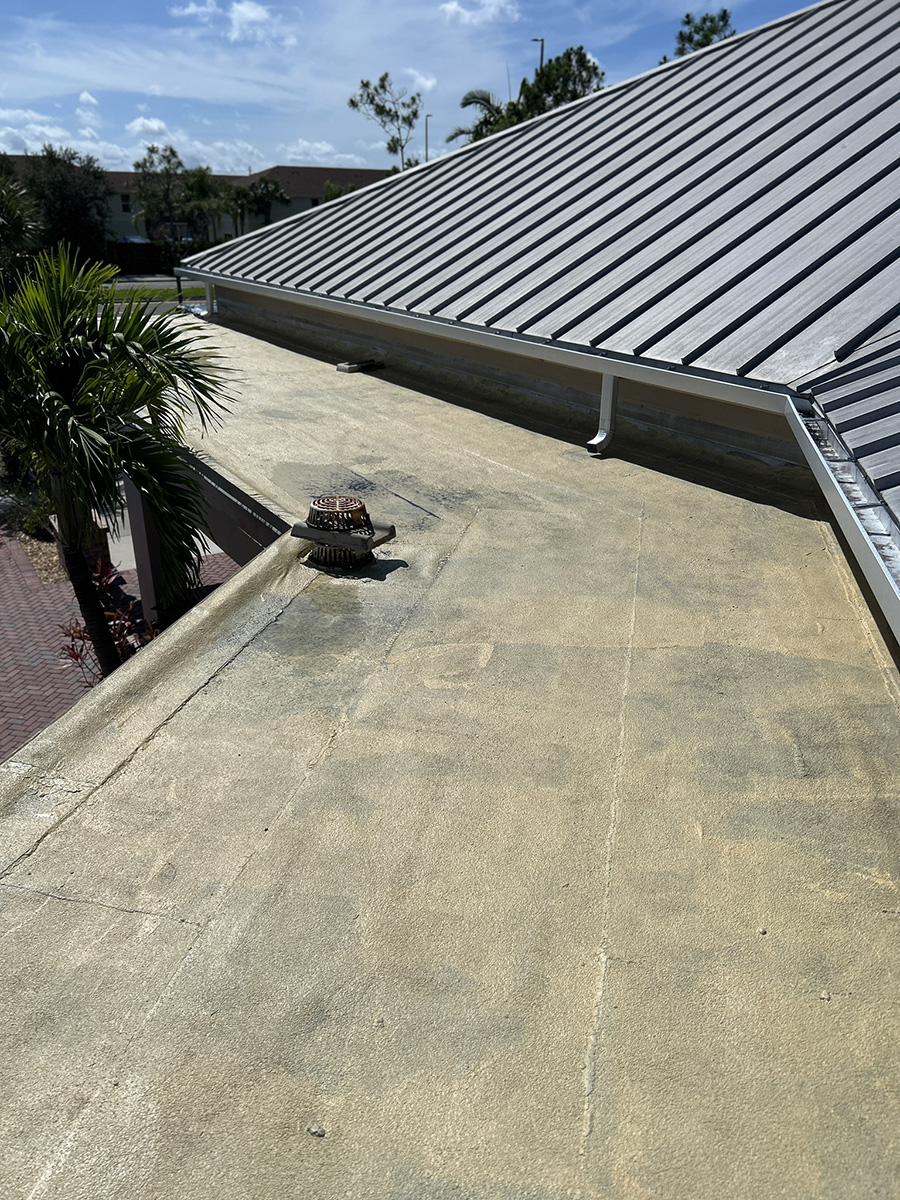
Getting the Surface Ready, Then Fixing It for Good
A coating system is only going to perform as well as the surface underneath it, so our team went through a careful four-step process:
- Cleaned and decontaminated the whole roof. We pressure-washed the entire membrane with commercial-grade cleaners to strip away years of dirt, oils, oxidation, and biological growth, so the coating would actually bond properly.
- Rerouted the HVAC condensate line. We cut out the cracked PVC piping, installed a new structural knee piece and heavy-duty fittings, and rerouted the whole line with proper slope so the AC runoff drains where it's supposed to instead of pooling on the roof.
- Reinforced every seam and detail. Every weak lap seam, curb, pipe penetration, and flashing junction got pre-treated with high-solids silicone mastic reinforced with polyester mesh, and we sealed up the leaking gutter joints along the roof edge too.
- Applied a seamless silicone coating. After priming the prepped surface, we applied a Gaco commercial silicone coating across the entire roof. It cures into a thick, rubber-like waterproof layer that shrugs off standing water and reflects up to 85% of the sun's heat.
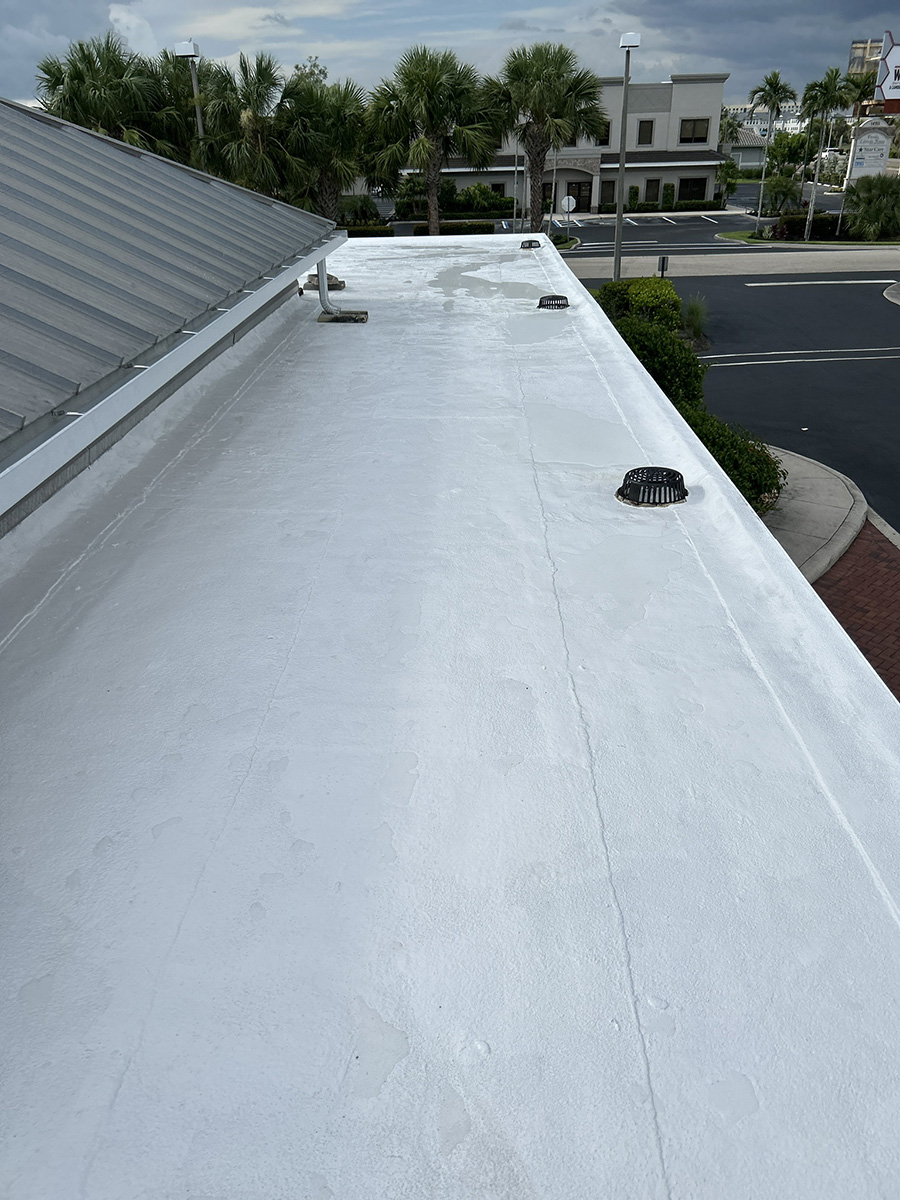
A Smart Fix With No Disruption
By choosing a fluid-applied restoration instead of a full reroof, Eric Dochinger and R&H Investments saved tens of thousands of dollars, and Gulf Coast Orthodontics never had to cancel a single appointment. The project was fully permitted through Lee County Community Development, and the restored roof now carries a 2-year McKinnis workmanship warranty along with full manufacturer material backing — solid protection heading into the next several storm seasons.
Frequently Asked Questions
Why choose a silicone coating instead of a full roof tear-off?
If the existing roof is still structurally sound and doesn't have widespread saturated insulation, a silicone coating is a smart alternative to replacement. It skips the noise, mess, and business disruption of a tear-off, seals everything into one continuous membrane, and typically costs about half of a full reroof. It's often treated as a maintenance expense for tax purposes too, which is a nice bonus for building owners.
How does a bad HVAC condensate line actually damage a roof?
Commercial AC units pull a surprising amount of moisture out of the air every day — we're talking dozens of gallons. When the condensate line cracks or just dumps onto the roof instead of into a drain, that steady trickle creates permanent standing water. Over time, that water grows algae, breaks down the asphalt in the membrane, and works its way into the seams through capillary action. Rerouting the line to a proper drain solves the problem at the source.
Can silicone coatings actually handle standing water?
Yes, and that's one of the big advantages over acrylic coatings. Acrylics are water-based and can break back down into liquid form if water sits on them too long. Silicone is moisture-cured and chemically stable, so it holds its watertight seal and stays flexible even in low-slope areas that collect water during heavy Florida rain.
Why use polyester mesh on the seams and flashings?
Roof penetrations, curbs, parapet walls, and seams move the most as the building expands and contracts with temperature swings throughout the day. Embedding polyester mesh into the silicone mastic at those spots reinforces them so the coating doesn't crack or tear as the building shifts.
Do you need a permit for a commercial roof coating in Fort Myers?
Yes. Both Lee County and the City of Fort Myers require a building permit and proof of Florida Product Approval for any commercial roof coating project. That process confirms the existing deck can support the new system, the materials meet local wind and fire ratings, and the finished job passes inspection. We handle all of that paperwork and the final sign-off, so building owners don't have to worry about it.
Visit our main Florida page
Visit our Fort Myers page
Location Information
- Address: 12701 Metro Pkwy B, Fort Myers, FL 33966
- Local Phone: (239) 426-8928
- Office Hours: Monday - Friday: 8am - 5pm • Closed Sat & Sun