
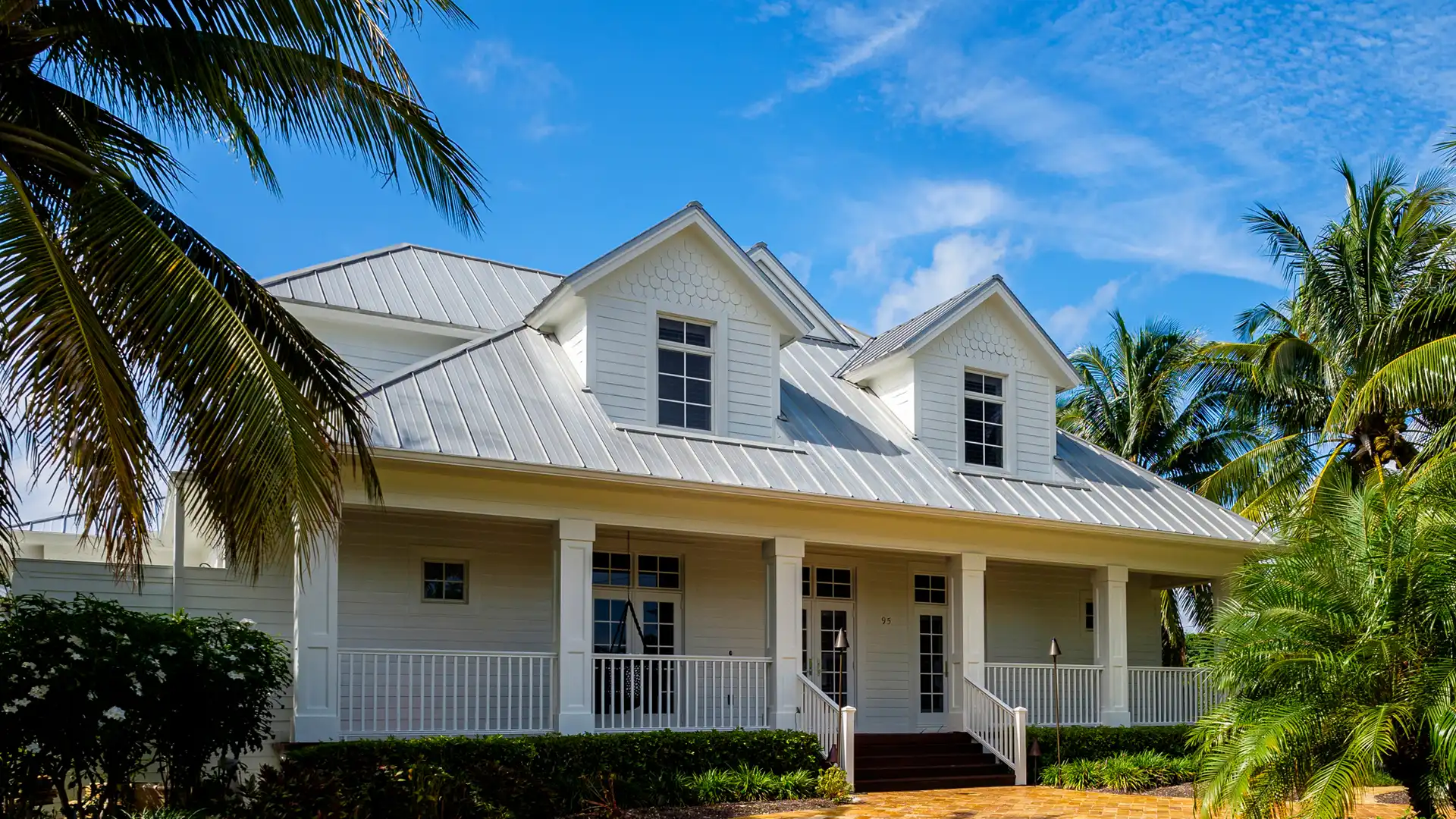
Roofing Contractors in Bonita Springs, FL — Residential & Commercial
McKinnis Roofing & Sheet Metal delivers storm-engineered residential, commercial, and multi-family roofing systems built for Southwest Florida’s intense subtropical sun, seasonal cloudbursts, and coastal hurricane winds. Operating under Florida Certified Roofing Contractor license CCC1337309, our teams provide turnkey roof replacements, preventative maintenance agreements, emergency leak diagnostics, and architectural sheet metal fabrication across Bonita Bay, Pelican Landing, Barefoot Beach, Spanish Wells, Vasari, Highland Woods, Bonita National, the Imperial River corridor, Bonita Beach Road, and throughout Lee and Collier counties.
City of Bonita Springs Building Codes, Coastal Wind Uplift & Severe Storm Hardening
Properties across Bonita Springs face varied wind and moisture environments, ranging from beachfront exposure along Barefoot Beach and Estero Bay to riverfront moisture along the Imperial River. McKinnis engineers every roof assembly to meet or exceed current Florida Building Code (FBC) and ASCE 7 structural design criteria:
- Exposure Category C & D Wind Uplift Engineering (ASCE 7 & FBC Chapter 16): Beachfront, bayfront, and open waterway properties in Bonita Springs are designated under high-exposure wind categories. We engineer mechanically fastened and fully adhered assemblies tested to TAS 114, FM 4470, and UL 1897 standards to resist ultimate design wind speeds ($V_{ult}$) from 160 to 170+ mph.
- City of Bonita Springs Municipal Permitting: All roofing permits are administered directly through the City of Bonita Springs Community Development Department. McKinnis manages the complete engineering submittal, submits Florida Product Approval (FL) schedules, records the mandatory Notice of Commencement (NOC) with the Lee County Clerk of Courts, and schedules all mandatory inspection milestones:
- Roof Sheathing / Re-Nailing Inspection: Verifying replacement of rotted decking and code-mandated 8d ring-shank nail patterns.
- Secondary Water Barrier (SWR) / Dry-In Inspection: Inspecting self-adhering polymer-modified bitumen underlayment adhesion, valley liners, and perimeter drip-edge flashings.
- Final Building Inspection: Official municipal closeout for Lee County property records and insurance underwriting.
- Mandatory Secondary Water Resistance (FBC R908.7.2): We apply a continuous self-adhering polymer-modified bitumen underlayment (peel-and-stick) or sealed-deck tape directly to the structural wood decking, creating a watertight secondary seal if primary tiles or metal panels are damaged.
- 8d Ring-Shank Deck Re-Nailing: During tear-off, our crews re-nail the existing structural wood roof decking using 8d ring-shank nails at 6-inch intervals along perimeters and field panels, doubling uplift resistance against hurricane suction.
- In-House ANSI/SPRI ES-1 Certified Edge Metal (FBC Section 1504.5): Over 70% of roof failures during tropical storms originate at the perimeter. Our in-house architectural sheet metal fabrication facility manufactures heavy-gauge coping caps, gravel stops, and fascia systems tested and certified to ANSI/SPRI/ES-1 pull-off standards.
- Master HOA & ARB Design Compliance: The majority of Bonita Springs homes reside within master-planned, deed-restricted communities. We work directly with HOA management and Architectural Review Boards (ARBs) to ensure replacement tile profiles, metal panel finishes, and shingle colorways comply with community design charters.
Florida Property Statutes, Insurance Mandates & Condo SIRS Regulations
- Condo Structural Integrity Reserve Studies (SIRS - F.S. § 718.112): Florida condominium and cooperative associations governing buildings three stories or higher are legally prohibited from waiving or reducing capital reserve funding for structural components, explicitly including the roof. McKinnis provides visual condition assessments, core sampling, remaining useful life verifications, and capital replacement budgeting to keep HOA and condo boards compliant.
- Milestone Structural Inspections (F.S. § 553.899): Multi-family and commercial properties reaching 30 years of age (or 25 years within coastal proximity) require formal milestone structural evaluations. Our team documents substrate conditions, perimeter flashing tie-ins, and waterproofing integrity to support engineering reports.
- The Florida 25% Reroofing Rule (F.S. § 553.844 & FBC Section 706): If storm or tree damage affects your roof, a mandatory 100% reroof is not always required. If your existing roof was permitted and built under the 2007 Florida Building Code or newer, property owners are legally permitted to execute code-compliant sectional repairs without triggering a mandatory total replacement.
- Roof Age & Non-Renewal Rights (F.S. § 627.7011): Florida law prevents insurers from cancelling or non-renewing a policy solely due to roof age for roofs under 15 years old. For roofs 15 years and older, homeowners have the statutory right to provide an inspection from a licensed roofing contractor confirming at least 5 years of remaining useful life to maintain coverage.
- Prohibition of Assignment of Benefits (F.S. § 627.7152): Florida law bans post-loss Assignment of Benefits (AOB) on property insurance claims. McKinnis works directly with property owners, providing itemized estimates and forensic photo documentation while you maintain complete control of insurance settlements.
- Strict Deductible Laws (F.S. § 817.234): It is a third-degree felony in Florida for any roofing contractor to offer to pay, waive, rebate, or absorb a property owner's insurance deductible.
- Uniform Wind Mitigation Credits (Form OIR-B1-1802): A code-compliant roof replacement featuring verified SWR, enhanced deck attachment, and impact-rated coverings provides the documentation needed to secure annual windstorm insurance discounts of 15% to 40%.
High-Performance Roofing Systems for Bonita Springs Properties
- Foam-Set Concrete & Clay Tile: Spanish S-tile, barrel, and contemporary flat tile profiles secured with Category 5 two-component polyfoam adhesive systems that eliminate fastener penetrations through the underlayment and lower attic temperatures through natural thermal mass.
- Marine-Grade Aluminum Standing Seam Metal: Structural aluminum architectural panels featuring concealed thermal-expansion clips that eliminate rust from saltwater Gulf spray while delivering 160+ mph wind uplift performance.
- High-Wind Architectural Shingles: Heavy-duty, Class A fire-rated shingles with reinforced nailing matrices and copper-infused algae-resistant granules engineered for Southwest Florida humidity.
- Synthetic Composite Slate & Shake: Impact-resistant, UV-stabilized polymer tiles replicating the appearance of natural slate or hand-split cedar shake without rot, moss growth, or excessive dead load.
- Commercial TPO & PVC Single-Ply: Energy-efficient, heat-welded white reflective membranes engineered for retail plazas, office centers, and restaurants along South Tamiami Trail (US 41) and Bonita Beach Road.
- Fluid-Applied Monolithic Roof Coatings: High-solids silicone and acrylic coating systems that encapsulate seams, seal leaks, and extend the service life of aging low-slope commercial roofs by 10 to 20 years without a costly tear-off.
Frequently Asked Questions
How does coastal and riverfront exposure affect roof engineering in Bonita Springs?
Properties near the Gulf of Mexico (such as Barefoot Beach and Bonita Beach) and along open waterways like the Imperial River face extreme wind shear and salt-laden humidity. Under ASCE 7 and the Florida Building Code, coastal structures are classified under Exposure Category D, requiring higher uplift engineering (Zone 1, 2, and 3 calculations) than inland properties. For metal roofs, marine-grade aluminum is strongly recommended over standard steel/Galvalume because aluminum does not contain iron, completely eliminating corrosion and rust from coastal salt air.
How does the City of Bonita Springs handle roofing permits and inspections?
Roofing permits in Bonita Springs are processed digitally through the City of Bonita Springs Community Development Department. The permitting packet requires submitting verified Florida Product Approval (FL) numbers, engineering uplift documentation, and a recorded Notice of Commencement (NOC) filed with the Lee County Clerk of Courts for projects exceeding $5,000. The city conducts three mandatory inspections: an initial deck re-nailing inspection (verifying structural wood repairs and 8d ring-shank nail spacing), an in-progress Secondary Water Barrier (SWR) underlayment inspection, and a final building sign-off upon project completion.
How do Florida Condo SIRS and milestone inspection laws impact Bonita Springs associations?
Under Florida Statute § 718.112, condominium and cooperative associations with buildings three stories or higher cannot waive or reduce reserve funding for the roof. Associations must maintain a fully funded replacement reserve based on a Structural Integrity Reserve Study (SIRS). In addition, buildings reaching 30 years of age (or 25 years within coastal zones) require Milestone Structural Inspections under F.S. § 553.899. McKinnis assists property managers and condo boards by performing visual roof condition assessments, remaining useful life verifications, core sampling, and capital replacement budgeting to ensure full statutory compliance.
What should I do if my insurance company threatens non-renewal because my Bonita Springs roof is 15 years old?
Under Florida Statute § 627.7011, insurance carriers cannot deny or non-renew coverage solely due to roof age for roofs under 15 years old. If your roof is 15 years or older, Florida law gives homeowners the statutory right to have a licensed roofing contractor perform an inspection verifying that the roof has at least 5 years of remaining useful life. Submitting this certified inspection report protects your policy from age-based non-renewal without requiring an unneeded, premature replacement. McKinnis provides certified condition reports for insurance underwriting.
Can I repair localized storm or fallen tree damage on my roof instead of doing a full replacement under Florida's 25% rule?
Yes. Under Florida Statute § 553.844 and Florida Building Code Section 706, the historical rule requiring an automatic 100% reroof if more than 25% of a roof section is damaged does not apply to roofs permitted and built under the 2007 Florida Building Code or newer. If damage from wind, hail, or fallen branches is isolated, property owners can obtain a permit through the City of Bonita Springs to perform code-compliant sectional repairs, provided the remainder of the roof assembly remains structurally sound and watertight.


